

How To Make Terrain Templates From Scratch On Empryian
Internal users from EPFL also equally academic or non-academic external users are invited to contact Arnaud Magrez for informations about equipment availability and access fees.

The facility is located in PH J0 511
(Contact: Arnaud Magrez and Wen Hua (David) Bi)
PHILIPS 10'Pert DIFFRACTOMETER
Nosotros use an Ten'Pert system equipped with a 1D 10'Celerator detector, Bragg-Brentano beam optics and parallel beam optics. The high power ceramic X-Ray tube allows for measurements both in line and point focus.
The Reflection-Transmission spinner is combined with a sample changer with i mag having 15 sample positions (maximum sample dimensions are 46mm diameter and 6.5mm thick).
The diffractometer is equipped with programmable divergence slits (or hybrid monochromator) as incident beam optics.
Rigaku Synergy-I single crystal diffractometer | Booking the Rigaku | |
MultiWire Laue back-reflection diffractometer | Booking the Laue | |
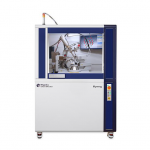
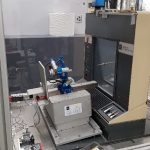
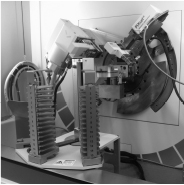
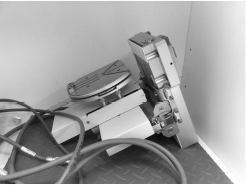
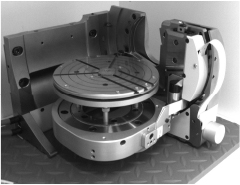
PANALYTICAL EMPYREAN DIFFRACTOMETER | Nosotros use an Empyrean system (Theta-Theta, 240mm) equipped with a PIXcel-1D detector, Bragg-Brentano axle optics (including hybrid monochromator) and parallel beam optics. The loftier power ceramic Ten-Ray tube allows for measurements both in line and point focus. The Reflection-Transmission spinner is combined with a sample changer with a maximum of 3 magazines having xv sample positions (maximum sample dimensions are 46mm diameter and six.5mm thick). The programmable XYZ stage allows sample positioning and mapping (10,Y: range 54mm, minimum step size: 10µm ; Z: range 25mm, minimum stride size 1µm). Maximum sample dimensions are 95mm length and width, and 53mm acme. Maximum sample mass is 2kg. The system allows stress and texture analysis using the quarter-circle cradle with Chi, Phi, 10, Y, Z motions (Chi-range:-3 to 93deg; Phi-range: 2x 360deg; 10-Y- range: 54mm; Z-range: 12mm, max. sample mass: 0.5kg) on which samples with a maximum diameter and acme of 80mm and 16mm respectively can be placed. From height to bottom: i) The reflection transmission spinner with the sample changer. two) the programmable XYZ stage. three) Eulerian cradle for stress and texture measurement. Booking the XRD Firmament Diffractometer | |
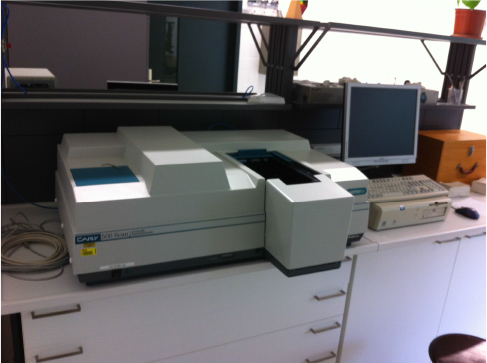
UV-Vis-NIR spectrophotometry | The Cary 500 (Varian) is a high performance UV-Vis-NIR spectrophotometer with high photometric performances in the 175-3300 nm range. The instrument is a powerful tool for materials characterisation. Thin films, solids, liquids and biomaterials tin can be measured in transmission and reflection. Contact: Arnaud Magrez Booking the Cary 500 Spectrophotometer | |
|
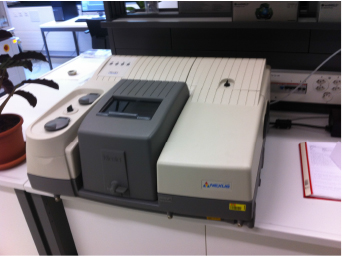
Thermo Nicolet Nexus 470 FTIR | This high-resolution spectroscope has a spectral range from 400 to 5000cm-1 with a spectral resolution of most 0.125cm-one. This instrument allows the measurement of thin films, solids, liquids as well as biomaterials. Contact: Arnaud Magrez Booking the Nicolet Spectroscope | |
| | Confocal Raman SpectroscopeA land of the art confocal Raman spectroscope will be installed in the laboratory in 2015. Contact: Arnaud Magrez Booking the Raman Spectroscope | |
Ten-Ray Fluorescence spectrometry | The Orbis PC Micro EDXRF analyzer arrangement is equipped with a Rh micro-focus X-ray tube (50kV and 1mA) and X-ray multiple Optic turret with 30um poly-capillary X-Ray eyes, 1mm and 2mm collimators. The detector is an Apollo XRF-ML50 Silicon Drift Detector with an energy resolution lower than 135eV at the Mn Kalpha. Limit of detection can be equally low as few ppm merely it depends on the chemical element, the matrix and the measurement duration. The sample bedchamber (D: 360 mm, Fifty: 310 mm) is equipped with a loftier precision XYZ sample stage (travel 100mm x 100mm x 100mm) which allows chemical mapping (with 512×400 pixels) ans line scans (1024pixels). Contact: Arnaud Magrez Booking the XRF spectroscope |


Complementary Centers for Material Label at EPFL
Interdisciplinary Center for Electron Microscopy CIME
High resolution SEM, TEM, STEM – FIB
Molecular and Hybrid Materials Characterization Center MHMC
Gel Permeation Chromatography, Dynamic Calorie-free Handful
Thermogravimetry analysis, Differential scanning calorimetry, Isothermal titration calorimetry
Atomic force microscopy, Ellipsometry
Ten-ray photoelectron spectroscopy, Auger electron spectroscopy
ISICX-ray
Structure determination from powders and single crystals
ISIC NMR Analysis
ISIC Mass Spectrometry
ISIC Elemental Analysis
Boosted characterization techniques are bachelor in theIII/V lab of IPHYS as well equally at the CMI

How To Make Terrain Templates From Scratch On Empryian,
Source: https://www.epfl.ch/schools/sb/research/iphys/fr/nos-services/crystal-growth-facility/material-characterization-platform/
Posted by: currywineve.blogspot.com
0 Response to "How To Make Terrain Templates From Scratch On Empryian"
Post a Comment